
Do you really know your own face? Why your practitioner sees it differently…
 By
By
14th October 2025
Updated: 27th January 2026
Updated: 27th January 2026





LOADING . . . PLEASE WAIT
 TWEAKMENT
TWEAKMENT & SKINCARE FINDER
CHOOSE AN AREA OF THE FACE OR BODY TO CHECK OUT YOUR SKINCARE AND TWEAKMENT OPTIONS


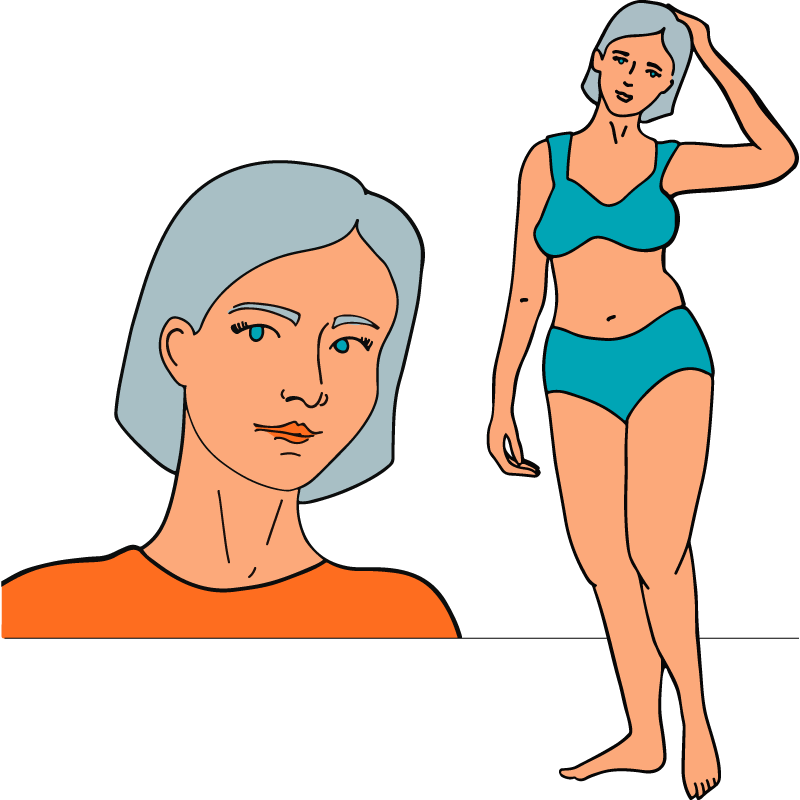
Forgive me for stating the utterly obvious, but when you look in the mirror you see… a mirror image of your face, which is not what everyone else sees when they look at you. Does this matter? Well, it does when it comes to aesthetic consultations.
The image you see in the mirror is a left–right flipped version of your face, often quite close up, in bright lighting if you’re in the bathroom, with every tiny asymmetry shouting for attention. And if, like me, you’re prone to taking too many selfies, of course you get the chance to pose, to change your expression, to improve what you’re seeing on screen. Other people – including your aesthetic practitioner – see you unflipped, from further away, in different light.
There IS a difference between ‘real’ and ‘mirror’ images – but it’s not anatomical; it’s psychological. Over the years, we become deeply familiar with our mirrored face thanks to something called the “mere-exposure effect” (I didn’t make that up. It’s a psychological phenomenon where people develop a preference for things simply because they are familiar with them), so when we see photos of ourselves, they can feel subtly “wrong” even when they’re perfectly accurate. At which point I have to add in my favourite factoid that emerged while researching this article – that we tend to have an inflated idea of our own attractiveness to the point where if we’re shown enhanced photos of ourselves, we think they’re more accurate than the actual, original photo. Again, I didn’t make that up, you can read about it on PubMed. Read the research here.
Add in the fact that all our faces are asymmetric, and it becomes easy to fixate on details others barely notice. And the same goes when we hear a practitioner’s view of our face – it can feel jarring if it’s not what we’re seeing. This is why good consultations try to align perceptions – but gently, as Dr Catherine Fairris explains. “I used to have patients hold the mirror, but a lot of people find that intimidating,” Dr Fairris says. “It’s quite confronting having a mirror held in front of you and asking you to talk through your concerns.”
“Now, I usually take a photograph of the patient then port it over to my overhead screen so that we’re both looking at the same image. They can see what I can see in real time.” Looking at a photo makes the whole process less personal than critiquing your own reflection – and it’s more objective than a selfie.
“I never point any concerns out,” says Dr Fairris. “I always ask patients what has brought them to see me. It’s really important to get their perspective on their concerns. You’d be surprised at the number of people who have something that jumps out to me – like deep forehead lines – but what they’re bothered about is a tiny line just above their top lip.”
Many patients want to get straight on with injectables, says Dr Fairris, forgetting, how much benefit any of us can get from getting our skin into great shape. She is always keen to give patients a “skin health MOT” with a skin analysis scanner to show skin issues that aren’t obvious under normal light (and which we can’t see in the mirror!) like underlying sun damage, or redness. “Being able to show areas of hyperpigmentation or increased inflammation is really quite helpful as it’s another visual tool. This is not about finding fault,” she adds. “It’s about making informed choices and prioritising treatments that improve the canvas of the skin as well as the contours of the face.”
Patients usually leave that initial consultation with some good entry-level skincare — a good sunscreen, retinoid and vitamin C if their skin can tolerate it – and advice to judge what their faces at “conversation distance”, because that’s how the world sees you.
Ultimately, what you see in the mirror isn’t wrong—it’s just one perspective…
Interested in other helpful tips and tricks for getting the most out of your tweakment experiences? Head to The Guide to view our full selection of articles.

Skincare
Curious to know which skincare products Alice and the TTG team actually swear by? Well, to celebrate the...
Lifestyle
How does LED light therapy work and is it really effective? Alice Hart-Davis gets the lowdown from Louise...

Skincare
No one wants ‘trout pout’ lips (and thankfully, aesthetics has rethought its previously overliberal use...
Lifestyle
Can home-use light therapy genuinely turn back the clock? Alice Hart-Davis put the Dermalux Flex device to...

Hi, I’m The Tweakments Guide chatbot (Beta Version).
I’ve been designed to answer your questions about tweakments, skincare, practitioners, or any related concerns. For example, you can ask questions like:
I will try to give you the advice you need but I am currently in training so I would love any feedback you might have.



 The Tweakments Chatbot