

How much filler did Alice’s MRI reveal?
 By
By
26th December 2022
Updated: 3rd February 2026
Updated: 3rd February 2026





LOADING . . . PLEASE WAIT
 TWEAKMENT
TWEAKMENT & SKINCARE FINDER
CHOOSE AN AREA OF THE FACE OR BODY TO CHECK OUT YOUR SKINCARE AND TWEAKMENT OPTIONS


Just how long can temporary dermal fillers last in the face? A lot longer than people expect them to, as I found out for myself.
As the grainy images from the magnetic resonance imaging of my face resolved into 3-D shapes on screen, my mind froze in disbelief. ‘So all the coloured parts that are showing,’ I ventured, ‘Is that all filler?’
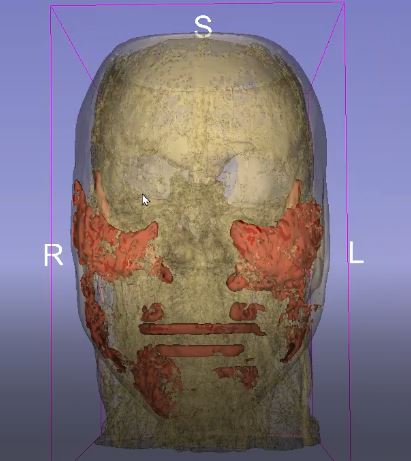
‘Yes,’ said Dr Simon Morley, the consultant radiologist who was talking me through the MRI scan. ‘I’d say there’s about 35ml of it altogether.’ I stared, amazed, at the patches across my cheeks, along my jawline, in my chin, under my eyes, in my nose-to-mouth lines, and my lips as, on screen, Dr Morley helpfully deleted the underlying image of my face, leaving a framework of filler. It simply didn’t make sense. ‘But.. 35 millilitres?’ I said, feebly. ‘That’s more than all the fillers I’ve had put together. And I haven’t had any for nearly four years!’
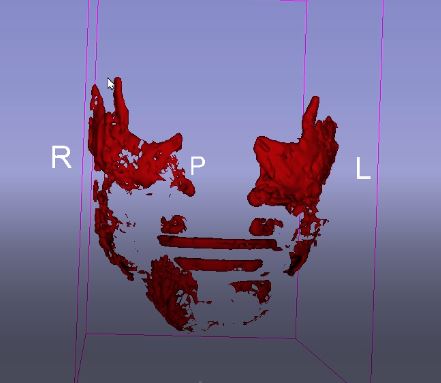
To say I was shocked was putting it mildly. And yet, part of me wasn’t, because reports of hyaluronic acid (HA) fillers lasting a lot longer than they ought have become a hot topic in the world of aesthetics over the past few years. I’ll try and explain. As a journalist, I’ve been reporting on tweakments for 20-odd years and have had a good deal of filler injected into my face to soften the impact of ageing as I tumbled through my 40s and 50s (I turn 60 next year).
Where have I had filler? Everywhere from my temples to my cheeks, my lips and nose-to-mouth lines, my jawline and chin, in the ‘tear trough’ grooves below my eyes, and in the tails of my eyebrows. But here’s the thing. Along with the rest of the world, I have always understood that these dermal fillers were temporary treatments, lasting for a year at the most, after which, if you want to maintain those plumped lips or that enhanced jawline, you need to be re-treated. Most aesthetic clinics invite patients back in every six-12 months to ‘refresh’ their fillers and keep their faces looking on point.
Yet over the past few years, evidence has been mounting that fillers may stick around for a good deal longer. The pioneer in bringing this issue to wider attention is Dr Mobin Master, an aesthetic radiologist based in Melbourne, Australia, after a number of cosmetic doctors referred patients to him for magnetic resonance imaging, wondering if the swelling around patients’ eyes could be due to filler. (Once the practitioner knows what shows up on the MRI, they can see precisely where the problems lie, and work out whether they need to dissolve that old filler before planning new treatment).
‘I probably first saw this issue on MRI around mid-2019,’ says Dr Master. ‘Many of these cases showed residual filler, some of which was from two years to 12 years old.’ Was he surprised? ‘Certainly, it was a surprising discovery,’ he says, ‘as the general understanding is that hyaluronic acid dermal filler was regarded as temporary and should self-dissolve over a period of approximately two years.’
Since then, Dr Master has published three articles in peer-reviewed journals about longevity of hyaluronic acid filler, with another due imminently. ‘From my research and some current new research, particularly in the mid face and around the eyes, filler seems to last a lot longer than we initially expected,’ he says.
Having followed Dr Master’s work, I had wondered what an MRI of my own face might reveal, so last year, at a point where (apart from one scrap of lip filler), I’d not had any hyaluronic acid injected in my face for 45 months, I booked in with Dr Morley, at the recommendation of aesthetic practitioner Dr Sophie Shotter, for a scan.
Analysing filler using magnetic resonance imaging is a specialised, painstaking process. Dr Morley is usually to be found working as a consultant head and neck radiologist at University College Hospital, but in his private work he is fielding an increasing number of requests from aesthetic doctors and surgeons to identify filler in faces where it may be causing lumps, or has migrated (or drifted), from its original position.
Dr Morley admits he was ‘completely astonished’ to see the extent of filler in my face – he’s normally looking at problematic filler, not at someone whose face seems absolutely fine. (I seem to remember the phrase ‘blown away’ being bandied about as he, Dr Shotter and I pored over the images together).
How does the imaging work? ‘HA fillers attract water,’ Dr Morley explained, ‘so you can depict the filler against the native fatty tissue in the cheeks, then by nulling the signal from the fat, you’re left with an image of the filler.’ So the 8ml of fat that I had transferred from my thighs to my face in 2019 wouldn’t be showing up in these images? No, said Dr Morley. The other substance I had injected in my face, albeit 15 years ago, was Sculptra, a ‘stimulating’ filler that encourages your face to grow more of its own collagen. Could that be showing? Again, no, because the carrier substance for Sculptra is not HA, and leaves the skin very quickly.
Because we’re injecting products that may last, it puts them in line with implantable devices and with that comes potential problems if treatment is not done properly, or in a sterile way.
I can see that actually, I’m lucky, given that that framework of filler is hanging out exactly where it was placed in my face, exactly where it ought to be. There’s more, for example in my left mid-face and cheek than my right, to counteract the natural asymmetry of my face. None of it has migrated. And, heavens, how ancient would my face look if it wasn’t in there?
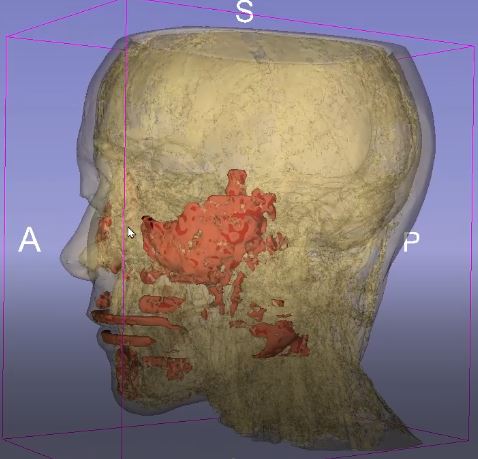
But why, I wondered, is there apparently more filler than I have had injected over time? That’s hard to say. Dr Morley suggests it might be because HA attracts water, so it appears as a larger volume on the scan. Dr Shotter wonders if it might be because over time, the filler has integrated with my facial tissues, so the scan is picking up filler that’s become part of my face as well as the filler that’s just still there.
Looking at the pattern of the filler in my face, I’m sure a lot of it dates from my treatment in early 2018 with Dr Tapan Patel, when he injected 10ml of filler all around my face (temples, cheeks, chin, jawline, lips) in one go. The straight lines across my lips look unusual – but there’s a reason for that. This was the 0.3ml that Dr Munir Somji added to each lip (in a straight line, with a cannula, laying it down in the body of each lip) in May 2021 to demonstrate his ‘placebo lip treatment‘. As for the filler in the nose-to-mouth lines, could that date back to work done by Dr Aamer Khan around 2010? But there’s also filler showing up in my tear troughs, and I know the last person to work on those was Dr Sabrina Shah-Desai in winter 2015, using micro-injections of filler in the whole periorbital area. Plenty of the filler that I’ve had over time isn’t there any more – like the tiny filler top-ups that Dr Khan would do in my cheeks and tear troughs every six or eight months around 2008-2012. And I must have had between 0.5ml and 1ml placed in my lips every 18 months between 2004 and 2014, but none of that is visible.
What’s the lesson here? I’m not for a minute suggesting that we should panic and avoid fillers – where would my face be without them? – but we should certainly be more thoughtful about whether we really need repeat treatment, and, most importantly of all, who is doing that treatment for us.
‘It shows that what we’re injecting has real longevity,’ says Dr Shotter. ‘We’ve all seen patients come back with a new lump from a treatment that was done a long time ago. But when done in the right way, this potential longevity is a massive positive point for patients. But because we’re injecting products that may last, it puts them in line with implantable devices and with that comes potential problems if treatment is not done properly, or in a sterile way.’
‘It’s important to realise that even though the longevity of filler will vary between individuals, and there may be traces or significant amounts of it present longer than we first thought, this doesn’t change the recommendation for repeating treatments,’ adds Dr Shotter. ‘Your natural ageing process will still progress, and if you want to mitigate that then maintenance filler treatments will still be required.’
The person who keeps Dr Morley busiest with requests for MRI of fillers is leading oculoplastic surgeon Daniel Ezra, who is himself about to publish a peer-reviewed study on dissolving HA fillers, including long-standing fillers. When patients come to him to discuss eye surgery, part of his routine assessment is ultrasonic screening, which can often pick up larger pockets of filler within the face. If needed, he then sends people for an MRI.
‘Fifty per cent of the patients coming to me for surgery have already had HA fillers and they often need filler dissolving before surgery,’ says Dr Ezra. ‘It could be just the patients I see, but I don’t think that’s the case. I see filler remaining in significant quantities for up to 20 years after it’s been put in. Often, people are very shocked. It’s so mentally ingrained that fillers dissolve after a year when that’s patently not the case, but psychologically, people think it’s not possible, because HA fillers are sold as a natural gel that dissolves and is dispersed by the body, and that narrative is very powerful.’
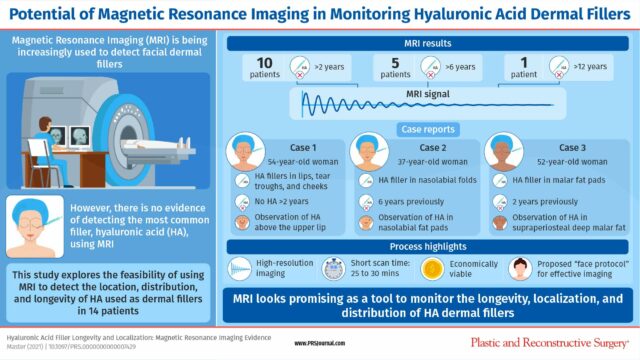
The possible longevity of hyaluronic acid fillers is clearly an area that merits more study. The potential for using MRI to monitor HA dermal fillers is one of the topics on which Dr Mobin Master has written a whole paper. Private MRI scans are pricey (I paid £700+ for mine), but if there were a specific protocol for this, Dr Master suggests it would be economically viable (see his infographic, below).
I asked the key filler brands for their views on the subject, and they all said that the longevity claimed for their products are based on the results of many clinical trials over the years (their full responses are further below).
Will this put me off having filler in future? No. The week after that MRI last winter, I had my next planned filler treatment – 7.2ml with Dr Raj Acquilla, and have just had the same amount added at strategic points around my face by Dr Sophie Shotter. That might sound like a lot, but at my age, it’s barely keeping pace with what the years are taking away. But it does make me reflect that I’ve been fortunate to have always been injected by outstandingly good practitioners. I’d suggest that it’s their skill in placing the product exactly where it needs to be that has meant it has stayed in place, rather than migrating along the path of least resistance into other areas of my face.
Note: If you’re wondering why it has taken me a year to write this article, it’s because what my MRI showed caused a good deal of interest among the doctors who saw it, and we had hopes of using this as a springboard for a proper study using MRI imaging on a number of patients who had had well-documented HA filler treatments over the years. That would have been fantastic, because while my case is interesting, it’s one single case, and I might be the anomaly in a world where most people’s filler dissolves and vanishes after a few months just like it’s meant to. But the project proved too tricky to pull off, so I’m writing it up for The Tweakments Guide, with thanks to everyone who has contributed.
‘Allergan Aesthetics, an AbbVie Company has studied the Juvéderm portfolio in clinical trials, according to the results the duration of effectiveness is 9-24 months with our products. Patients may experience shorter or longer duration of effectiveness with soft tissue fillers, but this has not been evaluated in a clinical study to date by Allergan Aesthetics.’
‘With regards to the longevity of dermal fillers, at Galderma, we can only comment on the clinical data and results for our own products – i.e. the Restylane range. Our dermal filler technologies have been in use for over 25 years, so we have a wealth of long-term data on post-treatment results, safety and efficacy across our various filler products – for example our Restylane Defyne filler lasts up to 1 year(1) as accredited by our studies and references below. We continue to invest in post-marketing studies to further understand the ‘real-world’ experiences of our products however at this time, we have not received reports from clinicians about the extended longevity of our products which would warrant further investigations. Of course, every patient is unique and injection technique and patient care have a significant role to play in the post-treatment experience, so we will continue to work with our global network of leading injectors for their feedback and insights on any longevity trends.’
1.Ascher B et al. Dermatol Surg 2017;43:389-395.
‘The average duration of HA dermal fillers is dependent on several factors including patients’ skin type, wrinkle severity, injection type and volume. For all Teoxane injectable products, longevity is based on results and evidence from clinical trials and studies. Below you will find some examples of such studies that were undertaken during the process of applying for FDA approval on the RHA range, which was ultimately approved:
Another important safety feature of HA fillers is that they can be dissolved via hyalase, allowing for quick and effective removal of any HA based products that are placed within the tissue.’
I’m waiting on a quote from Merz, which hadn’t arrived at the time of publication and hasn’t arrived since then.
I'm not for a minute suggesting that we should panic and avoid fillers – where would my face be without them? – but we should certainly be more thoughtful about whether we really need repeat treatment, and, most importantly of all, who is doing that treatment for us.
This is the best way to stay in the loop with our latest news and updates, including industry titbits and tailored offers.

Skincare
The trend for microneedling at home shows no signs of going away and for those of you who’ve been...

Tweakments
Tweakments in 2026 are shaping up to be all about enhancing skin quality. Not sharper cheekbones, defined...

Tweakments
There’s always, ALWAYS, a tantalising selection of new treatments and protocols popping up in the world of...

Skincare
Want to know what tweakments and skincare everyone was fascinated by in 2025? We’ve rounded up our

Hi, I’m The Tweakments Guide chatbot (Beta Version).
I’ve been designed to answer your questions about tweakments, skincare, practitioners, or any related concerns. For example, you can ask questions like:
I will try to give you the advice you need but I am currently in training so I would love any feedback you might have.


 The Tweakments Chatbot