

My Face… and The Filler Beneath: What My Second MRI Revealed
 By
By
20th January 2026
Updated: 2nd February 2026
Updated: 2nd February 2026





LOADING . . . PLEASE WAIT
 TWEAKMENT
TWEAKMENT & SKINCARE FINDER
CHOOSE AN AREA OF THE FACE OR BODY TO CHECK OUT YOUR SKINCARE AND TWEAKMENT OPTIONS


Two years ago, my article about an MRI scan that showed some 35ml of filler quietly residing in my face went a bit viral. Since that first scan, I’ve had more filler – and now I’ve had another MRI. Here’s the update, with expert input from key voices in the ongoing discussion around how long ‘temporary’ hyaluronic acid fillers may last – and what this means for our faces.
Over the 25 years I’ve been reporting on cosmetic procedures I’ve had a fair amount of dermal filler injected — the sort made from hyaluronic acid that, we are told, last for six to 18 months. Just a millilitre here and there, to support whichever parts of my face were starting to look a little deflated as the years took their toll – my cheeks, my lips, my temples…
Back in 2021, I was already aware of concerns being raised by some aesthetic doctors and radiologists around the world who were finding that, in some patients, these supposedly temporary fillers appear to hang around far longer than expected. So, curious to see what my own face would show, I booked in for an MRI scan.
What the scan revealed was a big shock.
Despite having had no filler injections for four years, an estimated 35ml of hyaluronic-acid filler was still visible throughout my face.
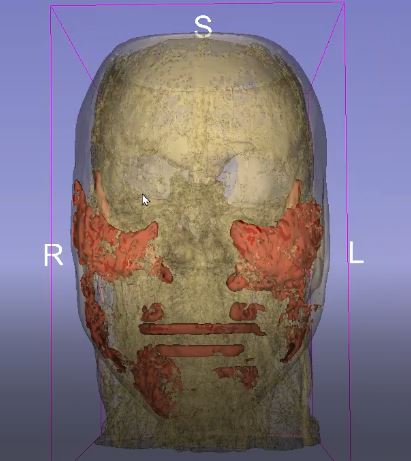
Why shocked? That’s a lot of filler. I’m sure I’ve had at least that much injected, but wasn’t this stuff meant to break down and vanish? Also, you might expect someone with that much filler in their face to look a bit ‘done’, or possibly like a puffer fish. I don’t. I look reasonably normal.
When the Daily Mail picked up the story, the reaction was extraordinary. Some senior practitioners took issue. It’s ridiculous, said one. The entire global filler industry is based on the premise that these products break down, so patients need regular retreatment. I know, I replied, but this is what my MRI shows. Another requested my scan, so he could get it analysed by a radiologist of his own choosing. I became used to delegates at aesthetic-industry conferences scrutinising my face like some real-life exhibit.
After a popular Brazilian news outlet reposted the story, dermatologists over there shared it enthusiastically on social media. I don’t read Portuguese, but the gist of their comments was clear enough:‘Is this true or is she lying?’
Readers were aghast. What was I going to do? Wasn’t I going to have all that filler dissolved? (No, it’s all sitting exactly where it was placed, doing a great job at holding my face up, and doing no harm). Was their own filler going to be with them forever? (Probably not, but we’ll come back to that). And wasn’t my filler migrating from where it was injected? Would theirs? (More on that later).
Some people developed their own theories. ‘You just faked the pictures,’ said one clinic-owner. ‘You’ve lied, haven’t you,’ said another, filming me on her phone as she approached at a conference. ‘You had it all dissolved and won’t admit it!’
View this post on Instagram
But many aesthetic practitioners, in the UK and around the world, messaged me to say that surprisingly-long-lasting-filler was not news to them at all. They saw it regularly among their own patients. At industry and press events, I began spotting my own MRI images in presentations, usually being used as a warning against filler, often conveniently followed by a pitch for a skin-tightening device.
What really irked the anti-filler brigade – particularly the facial plastic and oculoplastic surgeons who spend a good deal of time dissolving old filler from patients’ faces before they can operate (so I totally understand where they’re coming from) – was that, despite having this detailed picture of what lay beneath the surface of my skin, I had been foolish enough to have more filler…
In my view, appropriate treatment with filler remains the best non-surgical option for a face that is losing volume with age. Other treatments tighten, but nothing else helps with volume. The practitioners who treated me were some of the very best in the country. They felt my face merited treatment and afterwards – I didn’t look bizarre. I just looked fresher. Of course I’d say that – but then so do experts.
That was the prequel. Last year, I decided it was time for another MRI. I was curious to see what would show up now I had almost 16ml of newer filler on board (in my cheeks, temples, brow, lips, around my mouth, in my nose-to-mouth lines, my chin, my jaw) since that first scan.
Had the older filler gone? How much of the recent stuff was still around? And would there again be more of it showing than had been injected? I asked Dr Sophie Shotter, who did my most recent injections, to refer me for the scan, and Dr Simon Morley, the expert aesthetic radiologist who analysed my previous MRI, to talk us through the result.
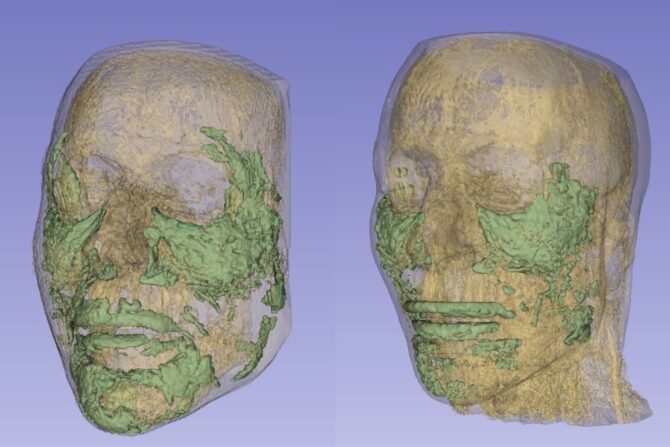
As Dr Morley began his explanation, I realised I was holding my breath. When he said that at least 60ml of filler was visible, my mind froze up. That’s an awful lot.
When he said that at least 60ml of filler was visible, my mind froze up. That’s an awful lot.
“The overall distribution of filler looks fairly similar to the previous scan,” explained Dr Morley. “But it’s more extensive in the lips and chin, and there are some differences in the temple region.” Crucially, he adds that the earlier scan may have underestimated the true volume present. “It’s the same scanner,” he says, “but we’re now using a different sequence, which gives us greater confidence in identifying filler and estimating volume.”
But it’s clear that a good deal of what was there before has not gone away.
Dr Shotter points out that we have precise records of exactly how much filler I’ve had injected between the two scans. “It’s interesting,” she says, “that the change from last time to this time shows slightly more filler than Alice has actually had injected in that period.”
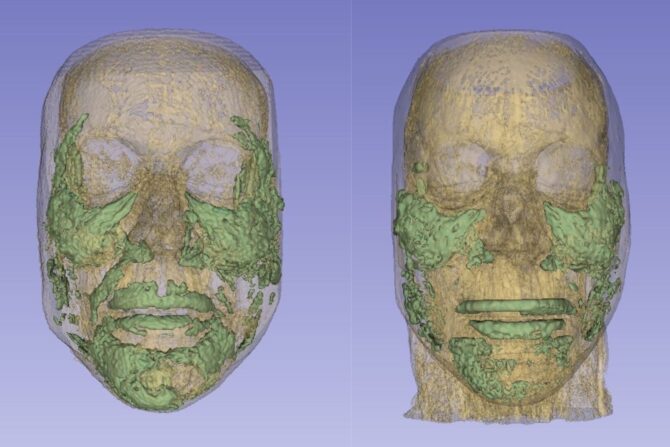
As well as having filler between the two scans, I’ve also had injections of biostimulators – six vials (7.5ml) of HarmonyCa, a hybrid injectable combining hyaluronic acid with a biostimulator, in my buccal cheek area (that’s the bit where, if you suck your cheeks in, you get a dimple). “There’s no trace of that on the scan,” she says. “Even though it contains cross-linked HA. That’s a real question mark for me.” I had Sculptra last year, too – though that contains no HA, so it wouldn’t show up on the scan.
One of the most puzzling aspects of facial MRIs is why filler so often appears at a greater volume than was injected. ‘The whole premise of this imaging interpretation is that it is visualising water,’ says Dr Morley. “Hyaluronic-acid fillers are hydrophilic, sucking up water and expanding, and that’s what we can see on the scan. My impression is that the volume we see on MRI is often two to three times the volume that was injected.”
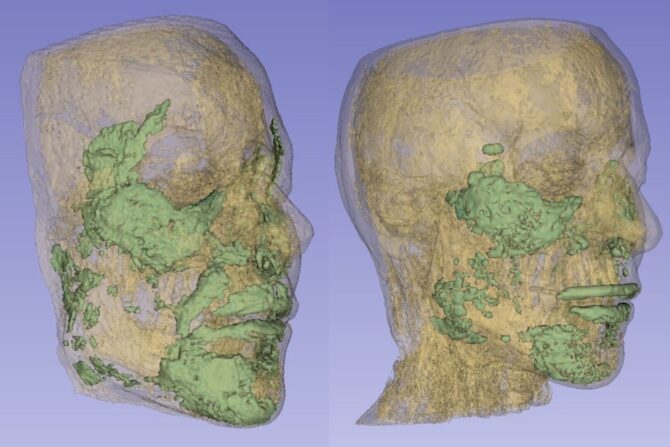
One of the biggest anxieties around filler in many people’s minds is the idea that it may wander off from where it was placed. Filler certainly CAN migrate, but as London-based aesthetic specialist Dr Ahmed El Muntasar frequently has to tell his patients, filler migration is measured in millimetres, not inches (one of them had asked him, in all seriousness, if a small lump on her clavicle was migrated filler from her nose).
Dr Mobin Master, an aesthetic radiologist based in Australia, was one of the first to discuss the issues of long-lasting filler and migration, and has become exasperated by the way people’s imaginations exaggerate the issue. “Filler doesn’t just walk off and get the bus to somewhere else,” he says.
Mine, thank goodness, is fine. “It’s reassuring to see that all your filler is where we want it to be,” says Dr Sophie Shotter.
“It’s reassuring to see that all your filler is where we want it to be,” says Dr Sophie Shotter.
In short – a lot of filler lasts a long time. Dr Master published the largest review to date of facial MRI studies looking at filler longevity in 2024. Across 33 patients, every single one showed evidence of hyaluronic-acid filler on MRI, including many who hadn’t had injections for five, 10 or even 15 years.
“The midface seems to be the biggest problem,” he explains. “We don’t know why the mid-face – tear troughs, cheeks, over the zygoma, the buccal fat pad – lasts so long. It seems to be dose-dependent – the higher the dose, the more likely it is seen to last. The filler here seems to have diffused and flattened, but it is still there, whereas filler in the lower face tends to dissolve on its own.”
In his experience, newer filler is easier to dissolve. “Fresh filler, under two years old, tends to respond better. Long-standing filler, particularly in patients who’ve had repeated injections over many years, can be very resistant, even after multiple dissolving sessions.”
There’s no doubt that MRI images of filler have contributed to a growing fear of filler among the public.
“The conversation around filler longevity and lymphatic drainage has scared a lot of people,” says Dr Shotter. “My personal view is that filler isn’t something to be scared of if it’s a good product, injected by good practitioners, under proper clinical conditions. You’re a great example of that. You look natural. You look really well.”
Along with every other person I spoke to for this article, she is keen for manufacturers to step up. “What we really need is funded research. We need proper scientific explanations for why this is happening, not just speculation.”
US oculoplastic surgeon Dr Kami Parsa is well-known for his cautious stance on filler but is even-handed in his approach (here’s a link to his Instagram post where he discussed my face as an example of someone who looks normal despite the quantity of filler stacked up under the surface).
My more recent MRI results didn’t surprise him. “We order facial MRIs regularly and see this pattern often,” he says. “Hyaluronic acid fillers have a cumulative effect. They don’t simply disappear and over time they can persist and expand beyond what was originally injected.”
“My advice in these cases is that any future HA filler use should be extremely selective. The biggest problem arises when patients begin chasing perfection. Fillers don’t lift the face, they don’t smooth every contour irregularity, and they don’t reverse time. When that line is crossed, both the patient and injector can gradually lose perspective on what’s realistic or even necessary.
He doesn’t believe everyone with residual filler needs to rush to dissolve it. “If the filler isn’t causing functional or aesthetic problems, I wouldn’t routinely recommend dissolving it. The exception would be if the patient is planning surgery — particularly facial fat grafting or lower eyelid blepharoplasty — where residual filler can interfere with outcomes and surgical precision.”
Another eye surgeon who orders a lot of MRIs and does a lot of dissolving is Mr Daniel Ezra, who uses the Endolift laser as well as injections of dissolving enzyme hyaluronidase to break up long-lasting filler. Like Dr Master, he points out that older fillers can be very hard to shift, since the hyaluronic acid in them tends to be more heavily cross-linked (the process that binds the HA molecules together in the filler gel) than in newer fillers. “Patients will also ask for MRIs to simply get a snapshot of their facial filler status, often after many years of injecting. We have seen an enormous spike in people wanting to remove filler, either because of complications like swelling or lumpiness but also, for those who have just decided they do not want any foreign material in their face even if they are not having any symptoms from it.”
D’you know what? I would. I still think it’s a great treatment when used sparingly, thoughtfully, and by experienced hands (and I’m happy with my results as shown in the pictures below). What these MRIs really demonstrate is not that filler is inherently dangerous, but that it is far more persistent than we once believed and deserves more respect than it’s often given.

We really need long-term, imaging-based research into dermal fillers. “What I’m trying really hard to do is encourage the filler manufacturers to do some research on this,” says Dr Sophie Shotter. “Let’s actually have a scientific explanation for why this is happening. Another key question is: how can Alice look so natural if she’s got 60 mils of filler sitting there?” She would also like to do a biopsy on a filler-rich part of my face, to take a detailed look at the skin tissues. We’re still discussing that. But if it happens, you’ll be the first to hear the results…
Allergan, makers of Juvederm:
“We appreciate your efforts to inform the public and are pleased to hear that your ‘filler is all in the right place and has not moved’ and as such continues to achieve the desired aesthetic result while remaining in place.
We recognise that the longevity of hyaluronic acid (HA) fillers, can vary depending on product type, treatment area, and individual patient factors. While our clinical studies typically track results for up to 12–24 months (24 months is considered an industry standard that balances meaningful clinical information with study feasibility), to satisfy regulatory requirements and evaluate safety and efficacy, we understand that, in some cases, filler may remain visible beyond this timeframe.
This reaffirms the fundamental importance of having treatments administered by qualified healthcare professionals (HCPs); doctors, dentists, or nurses, who possess expertise in facial anatomy, safe injection techniques, and tailored treatment planning. Their knowledge helps maximise both safety and aesthetic outcomes, ensuring product placement remains optimal and complications can be managed appropriately.”
Merz: makers of Belotero HA
We are writing in response to your request for comment regarding hyaluronic acid filler longevity.
We can confirm that the lifetime of Merz Aesthetics UK Ltd’s Belotero portfolio ranges from 3 to 18 months, depending on the specific product and the degree of cross-linking. Regarding the study of their longevity, the degradation of hyaluronic acid fillers is typically assessed as part of the medical device approval process. For the Belotero portfolio, the required evidence was submitted during this approval process.”
I know you’ll have lots of questions around this whole topic – send them through to me on Instagram @alicehartdavis and I’ll do my best to address them all.

Tweakments
Tweakments in 2026 are shaping up to be all about enhancing skin quality. Not sharper cheekbones, defined...

Tweakments
There’s always, ALWAYS, a tantalising selection of new treatments and protocols popping up in the world of...

Skincare
Want to know what tweakments and skincare everyone was fascinated by in 2025? We’ve rounded up our

Tweakments
Another year, another chance to trial a bewildering range of tweakments, all in the name of work. From...

Hi, I’m The Tweakments Guide chatbot (Beta Version).
I’ve been designed to answer your questions about tweakments, skincare, practitioners, or any related concerns. For example, you can ask questions like:
I will try to give you the advice you need but I am currently in training so I would love any feedback you might have.




 The Tweakments Chatbot